
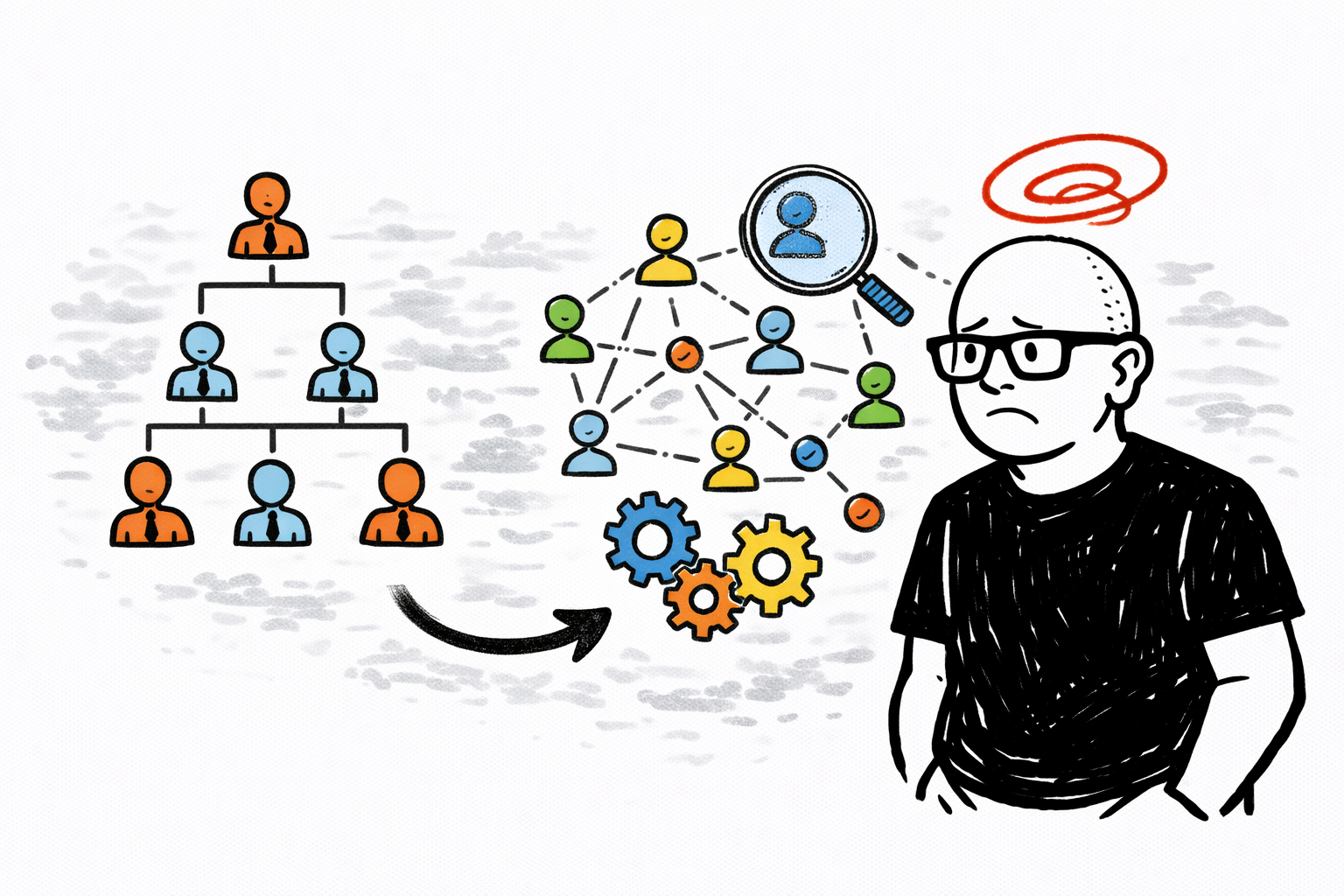
Learning to See Organisations Differently
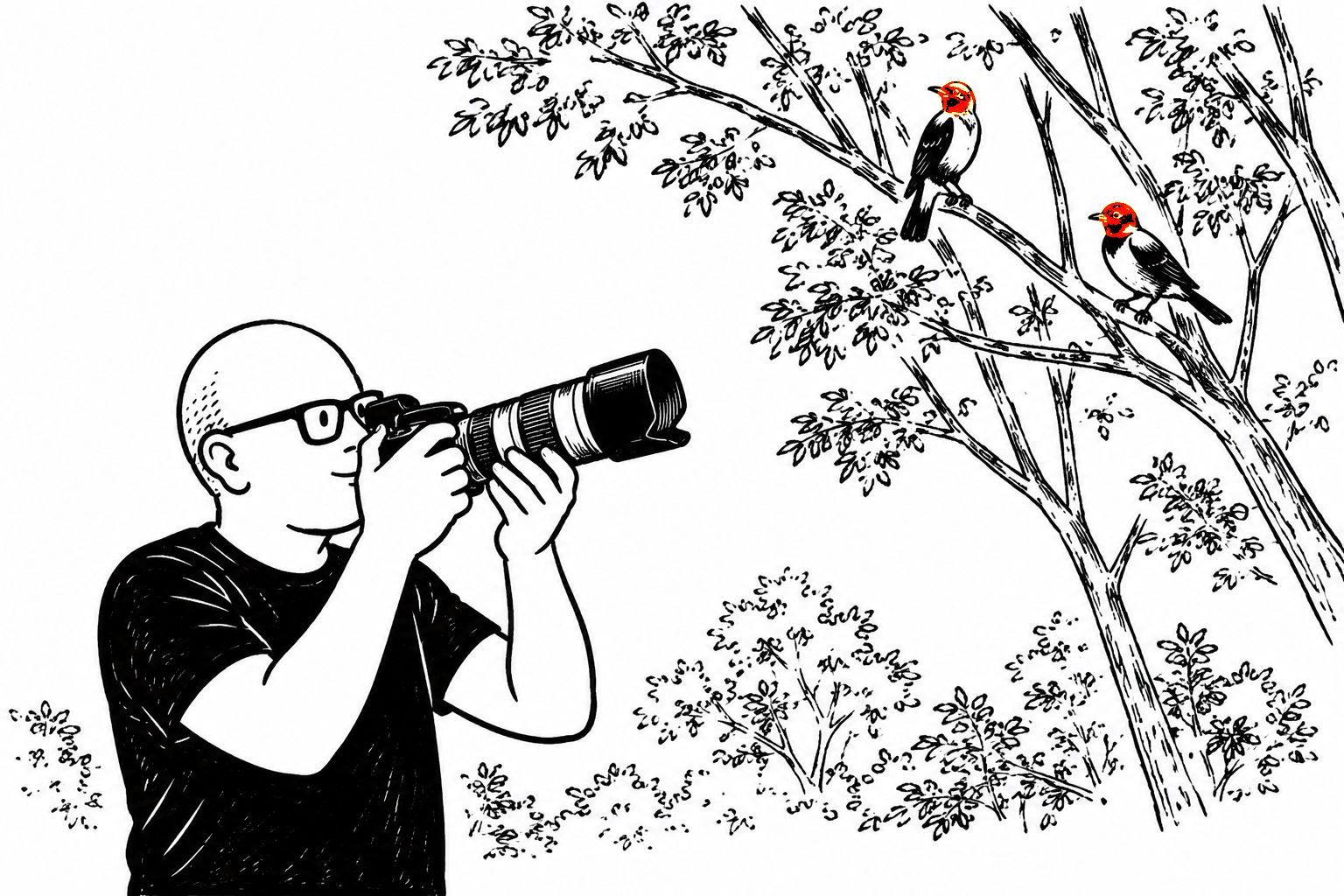
I cannot remember the name of the small eucalyptus purchased on sale from Bunnings. That seems important now, though it mattered less when I planted it. At the time, it was a small tree placed in the far corner of the garden with a fairly simple intention. I wanted to feed the New Holland honeyeaters that regularly moved through the yard. They were already part of the garden’s rhythm, arriving in quick bursts, calling sharply, disappearing again into the shrubs and fences and neighbouring trees. Planting the eucalyptus felt like a small act of welcome. A gesture of provision. Ten years later, the tree is about five metres tall and covered in small pink flowers. It has become something other than what I imagined. The New Holland honeyeaters do visit it. In that sense, the plan worked. But the tree was never only theirs. Wattlebirds arrive with their rougher, more assertive presence. Other honeyeaters come through too, drawn by nectar and movement. Superb fairy-wrens dart in and out of the lower branches, not for the flowers exactly, but for the insects that the flowers attract. In the evening, a ringtail possum and its joeys visit the tree, moving through it with a different tempo altogether. Occasionally, a grey-headed flying fox arrives from the new local colony, an animal not always welcomed by nearby fruit growers, but here, in this garden, it appears as part of the same wider set of relations. It is welcome here. The tree has become a meeting point. Not a symbolic one only, but a practical one. A place where nectar, insects, shelter, shade, habit, hunger and timing gather together. What began as a planted object has become a small ecological field. Its meaning is not held in the tree alone, but in the relations that form around it. The tree is not simply “in” the garden. It is helping make the garden into a different kind of place. The tree has also changed how the garden sounds. In the afternoons, corellas, galahs and cockatoos pass overhead, sometimes unseen at first, announced by their calls before their bodies appear above the roofline. Their sound belongs to the wider suburb rather than only to the backyard. It comes from above, across fences, roads, powerlines and the remnant trees that still hold the memory of a much larger habitat. Their calls are not background noise. They are a reminder that the garden sits inside a larger aerial world, one that birds read and use in ways I can only partly understand. Closer in, the rainbow lorikeets arrive with less subtlety. They are bossy, bright and possessive, turning the flowering tree into a noisy argument over nectar. They do not simply feed. They claim, chase, scold and return. Their colour almost feels too vivid for the garden's muted greens and greys, yet they belong completely to it. The eastern and crimson rosellas are different. They feel more delicate, more occasional. I mostly see them when the tree is in flower, as if the pink blossoms briefly open a door through which they re-enter the backyard. The hammock sits close to the lemon tree, so the garden is not only eucalyptus blossom and bird movement. There is citrus in the air too, especially when the leaves are brushed or the weather is warm. The smell is sharp, clean and slightly oily, mixing with the softer scent of flowering gum, damp soil, dry mulch and the faint sweetness of nectar. After rain, the garden smells heavier. The eucalyptus leaves release that familiar resinous scent, while the lemon tree cuts through it with something brighter. It is a smell of domestic care and wild visitation at once. From the hammock, the backyard is never silent. There is the high chatter of honeyeaters, the scratch and shuffle of small birds in the foliage, the sudden wingbeat of lorikeets arriving too fast, the rasp of wattlebirds, the thin contact calls of fairy-wrens, and the overhead clamour of parrots moving through the afternoon. The ding-ding of a crimson rosella in another nearby tree. My attempts to mimic the sound are met with a harsh chatter. In the evening, the sound changes again. The birds withdraw. Possums begin their quieter work in the branches. Leaves move without wind. The garden becomes less visual and more textural. I wander to the corner with my torch to say hello to the possumn and to curse it eating my roses as well, but it is welcome in this tree. This is where the anthropological view becomes useful. It asks me not to see the backyard as a private domestic space occupied by a few visiting animals, but as a shared and negotiated environment. The animals are not decorations added to human life. They are participants in the making of place. They arrive with their own needs, patterns and risks. They move through fences, property lines and human intentions without much concern for the categories we place around them. The backyard, then, is not only a garden. It is a habitat, corridor, feeding site, refuge, territory and threshold. Sitting in the hammock beneath the flowering eucalyptus, close to the lemon leaves, close to the birdbath, I become aware that care is often less grand than we imagine. It is not always rescue, intervention or expertise. Sometimes it is water in the birdbath, filled daily. Sometimes it is planting for a flower that will open in another season. Sometimes it is learning to sit still long enough to notice who comes, when they come, and what they do once they arrive. The first tree was planted for a single species, but it has taught me to think beyond that single-species intention. The New Holland honeyeaters were the beginning of the relationship, not its limit. The tree has drawn me into a wider multispecies awareness, where care becomes less about choosing one animal to help and more about creating conditions in which many forms of life can pass through, feed, shelter, rest and return. There is also a lesson in time. Ten years is a long time in the life of a garden, but not such a long time in the life of a tree. The eucalyptus has grown slowly into significance. Its current flowering is not just a seasonal event, but the result of a decade of waiting, weather, soil, roots and repeated visits. The garden remembers through growth. Relationships take shape through recurrence. The birds know the tree now. The possums know it. The insects know it. The flying foxes may know it only occasionally, but even that occasional visit matters. I sit beneath it and think about what it means to share an urban space with animals whose lives are often made difficult by the very environments we have built. A backyard cannot undo habitat loss. A flowering tree cannot resolve the conflicts between flying foxes and fruit growers, or between urban expansion and the animals displaced by it. But it can still matter. It can become part of a patchwork of small refuges, minor corridors and everyday acts of repair. The garden is not peaceful in the simple sense. It is busy, contested, scented, noisy and alive. The lorikeets argue. The honeyeaters negotiate access. The fairy-wrens hunt through the insects. The rosellas appear and disappear with the flowering. The possums come at dusk. The flying fox arrives from a colony that some people would rather not have nearby. The lemon tree perfumes the air beside me while the eucalyptus feeds animals above me. So I have planted another flowering eucalyptus. This one will flower at a different time of year. That feels like a small adjustment in the rhythm of care. Not just more planting, but more attention to timing. More attention to the gaps between seasons. More attention to who might be hungry when one tree has finished, and another has not yet begun. Perhaps that is what the first tree has taught me. Caring for backyard animals is not about imagining myself as the centre of their world. It is to become more attentive to the world's already unfolding around me. It is to plant, watch, refill, wait and learn. The far corner of the garden is no longer far away. It has become one of the places where relationships happen.
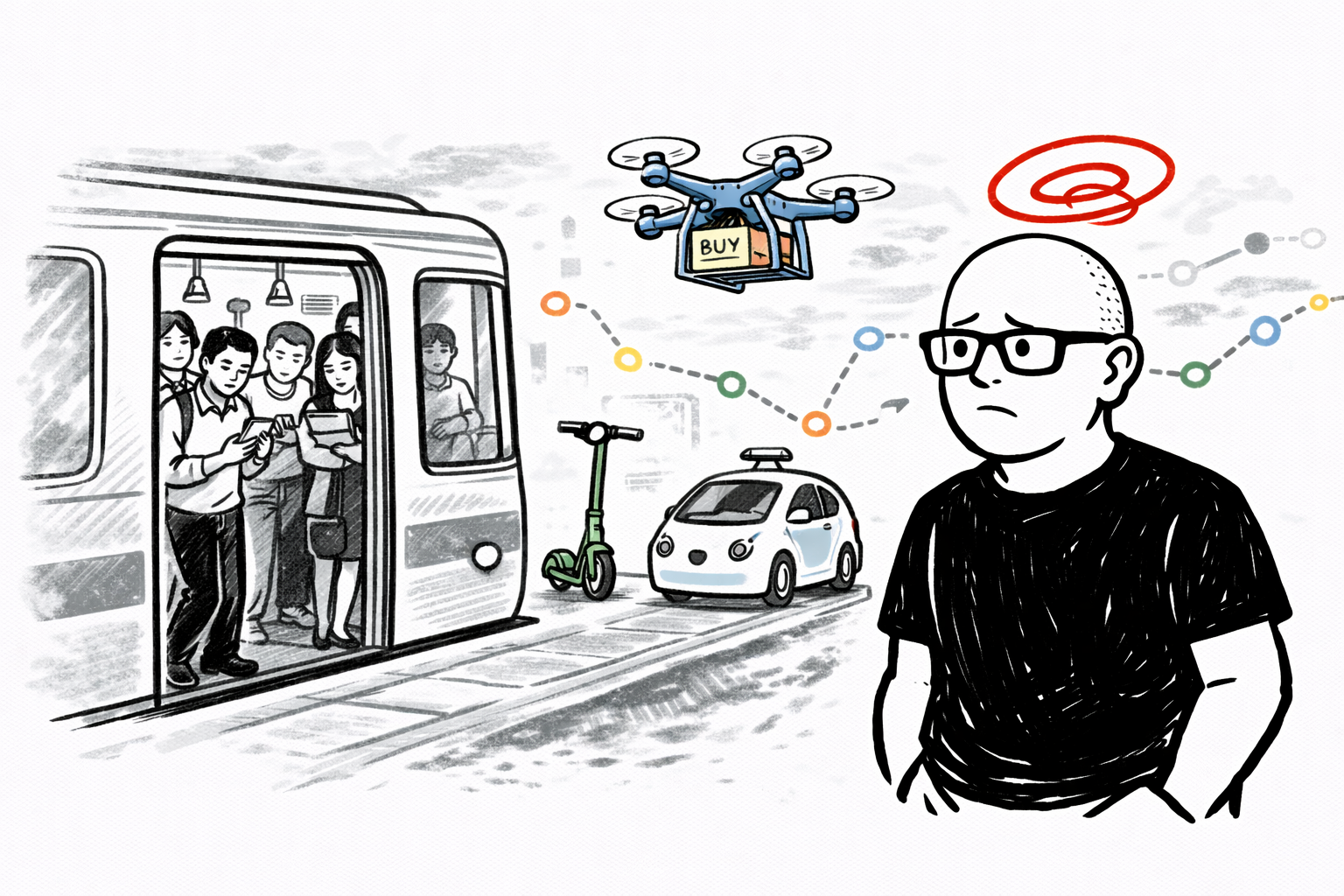
A few years ago, I would never have imagined becoming an ethnographer of the train. But geopolitics has a way of rearranging the mundane. As fuel prices surge, a consequence of unnecessary war in the Middle East and trade wars, all decided in distant corridors of power. The ripple effect has forced me to switch from my car to public transport. From driving the lines, tracing my own routes through the road network insulated in steel and glass, I was thrown in with everyone else. What I found has become curious. A train line is not simply a route through space. It is a line, physical and imagined, entangled with a multitude of lives, intentions, and temporalities. Knotting together and unravelling at each station along the journey. A student boards at one stop, a shift worker departs at the next, and a consultant opens a laptop three stations later. The line gathers and disperses, gathers and disperses. Each node of the collection station, platform, and carriage doors rounds up and orders human packages. People gather, but they do not meet. They are collected. Sorted. Loaded. Pack away. Arriving at the station or stop, bodies pour out in a slow, uniform current, phones in hand, heads bowed. I couldn’t shake the image of workers leaving the machine in Fritz Lang’s Metropolis . The same shuffling gait. The same downcast eyes. But these aren’t labourers broken by industrial discipline. These are knowledge workers, voluntarily tethered. I began to think of the smartphones as umbilical cords. Unnecessary ones at that. These digital entanglements connect each person to hegemonic entities they can barely name or conceive. Big tech, algorithmic processes, AI, data architectures, concepts that don’t enter the mind of the commuter. So who is nourishing whom in this arrangement? The user feels connected, sustained. The platform extracts attention, data, and behavioural surplus. Both parties believe the other is the dependent. And then there were the laptops. People are already working buried in emails, spreadsheets, Slack messages — before they’d arrived at the office. Whatever happened to the Australian ethos of working to live rather than living to work? That sensibility assumed a clean boundary between labour and leisure, between the office and the beach. The smartphone has erased or weakened that line. Work, rest, and distraction occupy the same device, posture, and glazed expressions. You cannot tell from looking whether someone is answering their manager or scrolling memes. The activity is identical. I noticed all of this because I was reading Tim Ingold’s Life of Lines , a physical book, held in two hands, which, of course, is its own technology of insulation. Ingold distinguishes between the wayfarer, who moves attentively through the world, and the transported person, who is essentially a parcel moved from one destination to another. My fellow commuters had gone further. They were being transported through physical space while simultaneously being transported through digital space. Present in neither. Autonomous in neither. The train line, this thing that entangles us all at different points of time and space, had become merely a conduit, its knots of human meeting pulled tight and never opened. The car windscreen has been replaced by the phone screen. The private cabin has been replaced by the digital bubble. The insulation persists. It just changed the substrate. I looked up from my book and saw lines everywhere. The fixed line of the rail corridor. The invisible lines of the wireless signal. The lines of text on every screen. The lines of force run from Washington to fuel pumps to household budgets to train tickets. And the line I was travelling, entangled with a multitude at different points of time and space, knotting and unknotting at every station. We were all following lines. None of us chose quite where they led. Perhaps the most honest thing I can say is this: I am one of the drones, too. I was reading a book about lines while being carried along one, performing a more prestigious version of exactly what everyone else was doing, absent from the shared space, following a thread of my own. The only difference was the moment I looked up. Maybe that’s enough. The ethnographic instinct isn’t immune to the pattern. It’s the willingness to notice you’re in it.